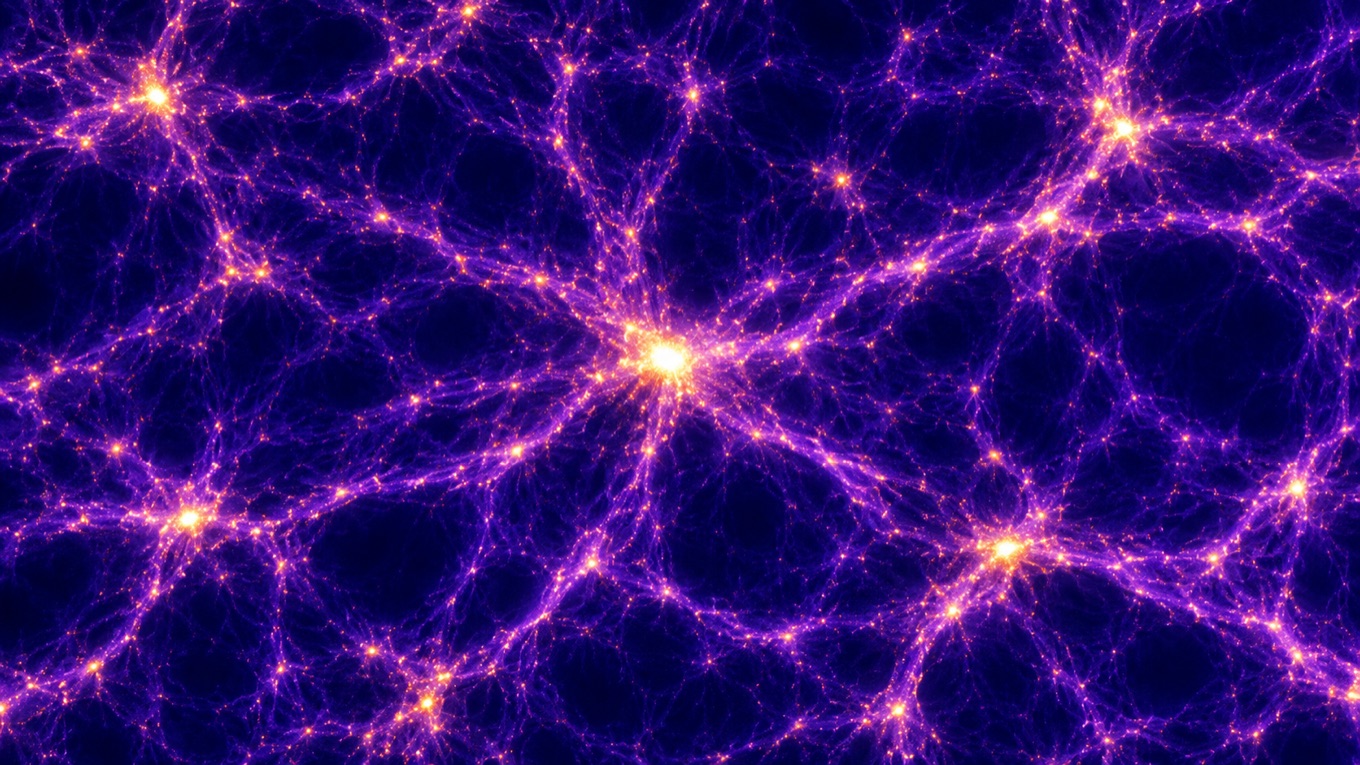
A telescope sees light that has already crossed the space between a distant galaxy and Earth. To work backward from that light, astronomers need to know what the intervening gas could have absorbed. Lumina, a simulation described by researchers at MIT, Harvard and other institutions in October, follows both the sources of early light and the gas that changed as the light passed through it.
The calculation spans a region about 1.6 billion light-years wide and follows roughly two billion years of cosmic history. Its designers built on the IllustrisTNG galaxy-formation model, adding a way to track how radiation travels and interacts with matter. On the Frontier supercomputer at Oak Ridge National Laboratory, the team followed about half a trillion computational elements, including dark matter particles and cells representing gas.
Two changes in the gas emerge from that shared history. Ultraviolet light from young stars and galaxies strips electrons from hydrogen, allowing subsequent radiation to travel farther. Helium requires more energetic radiation. In Lumina, growing supermassive black holes supply that harder light. Putting both processes in the same simulated region gives researchers a common population of galaxies against which to examine the two results.
Where the telescope enters the test
A simulated sky can be examined at two different ages to see how one structure developed. An observer gets a single view of a distant object at the age its light records. Comparing many such views with a predicted distribution of galaxies offers a way to challenge the calculation. A mismatch would be scientifically interesting even if the simulated universe looks convincing to the eye.