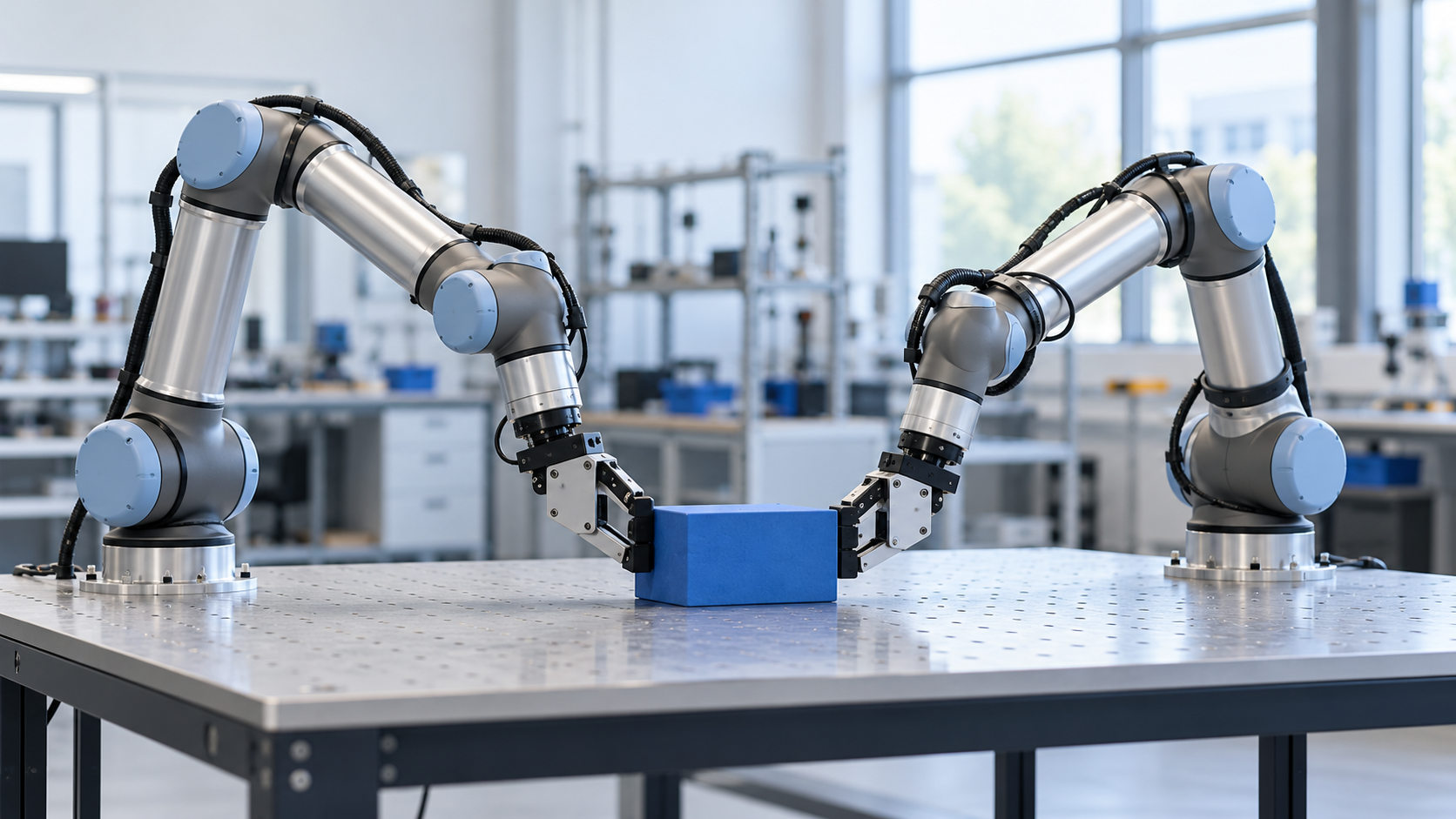
Sereact and Teradyne Robotics announced an October 21 partnership combining Sereact’s Cortex software with Universal Robots arms. The companies say hundreds of UR robots have already shipped in dual-arm systems to European customer sites, with returns handling among the applications.
Sereact identifies deployments with CEVA Logistics for Zalando in Greven, Germany, and Świebodzin, Poland. Its announcement describes model training in simulation, hardware benchmarking before deployment and computing at the robot cell. These are supplier-reported operating examples, rather than an independent comparison of productivity or reliability.
NAOAT analysis
For a warehouse evaluating this type of system, the difficult question is how to define a representative return. A demonstration can show a successful pick, while the business process may require decisions about packaging, damage, orientation and the next destination. A useful acceptance trial would deliberately include items that challenge those boundaries and specify when the robot should pass the task to an employee.
The scorecard should follow goods through the whole cell. Operators could record completed items, interventions, damaged products and time spent recovering from exceptions. Counting attempts alone would obscure whether automation actually frees staff to do other work. Tracking performance by item category would also expose a system that handles the common cases well but repeatedly stalls on a smaller, important group.
Training therefore needs to reach beyond starting and stopping the arms. Staff should understand how to recover a rejected item, report an unfamiliar failure and identify which software version was active. For a company expanding across sites, those records become a practical way to decide whether a demonstrated capability transfers to its own inventory and operating conditions.