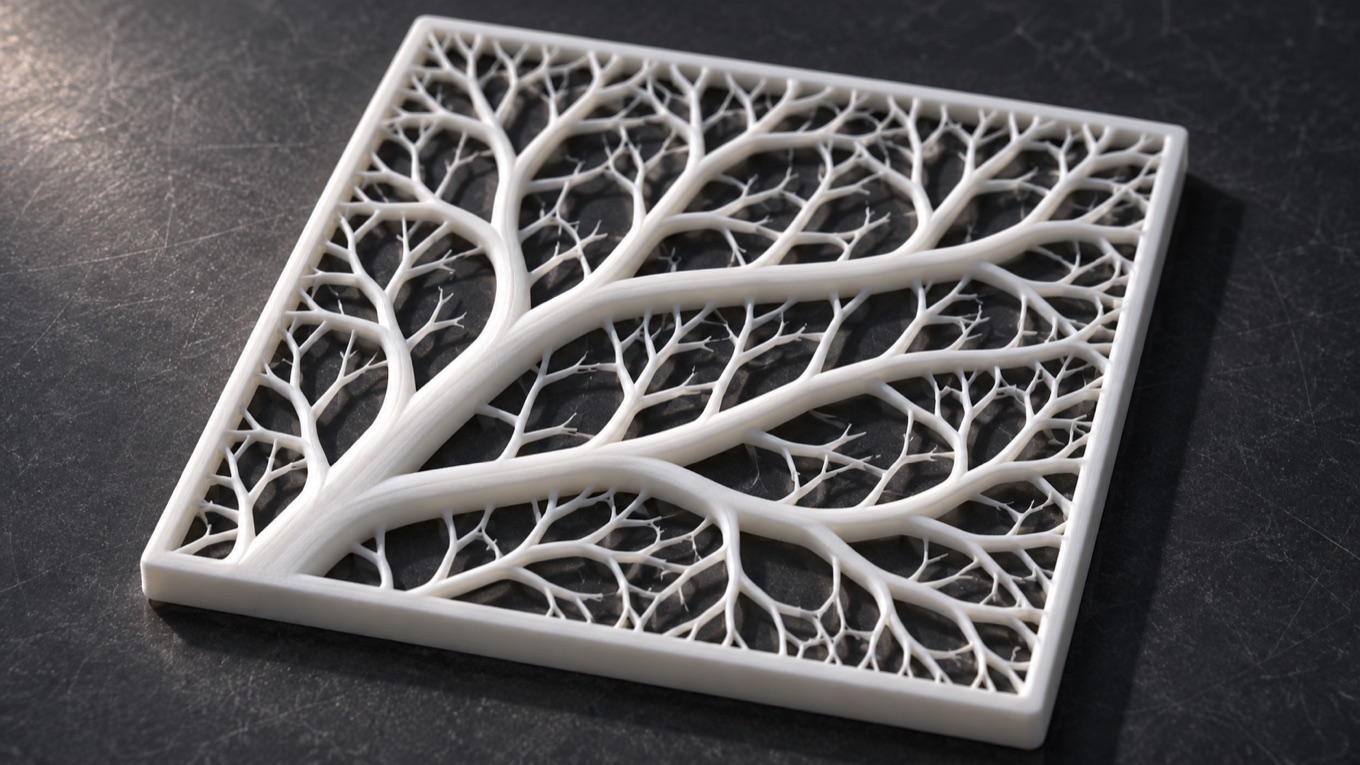
A square of printed polymer roughly the size of a credit card can contain load-bearing beams that differ in length by orders of magnitude. In tests reported in Nature on November 11, researchers found that such a network could absorb a blow while spreading deformation through the sample. In one demonstration they put a fragile object in the middle and protected it with a denser web near the edges.
The group, which included researchers at MIT and Northeastern University, borrowed an idea from leaf veins and insect wings. Long members span much of a structure while progressively smaller ones connect to them. In the researchers’ design software, the starting beam thickness and the rate at which later beams narrow determine the geometry. Adjusting those two quantities produced networks with different stiffnesses.
The researchers printed the patterns and compared their response to compression and falling weights with that of regular lattices and honeycombs. The repeating structures tended to concentrate damage. The varied networks gave the load more ways around a region that had started to give way.
Where a crack travels
For a designer of protective packaging, stiffness alone tells only part of the story. Two inserts can resist the same initial squeeze yet transmit different forces to the object inside as they collapse. The experiment makes the path of deformation a quantity worth examining alongside the initial resistance.
A commercial insert would introduce constraints absent from a small square specimen. The smallest beam a production printer can reliably reproduce places a practical limit on the range of geometries a designer can exploit.